
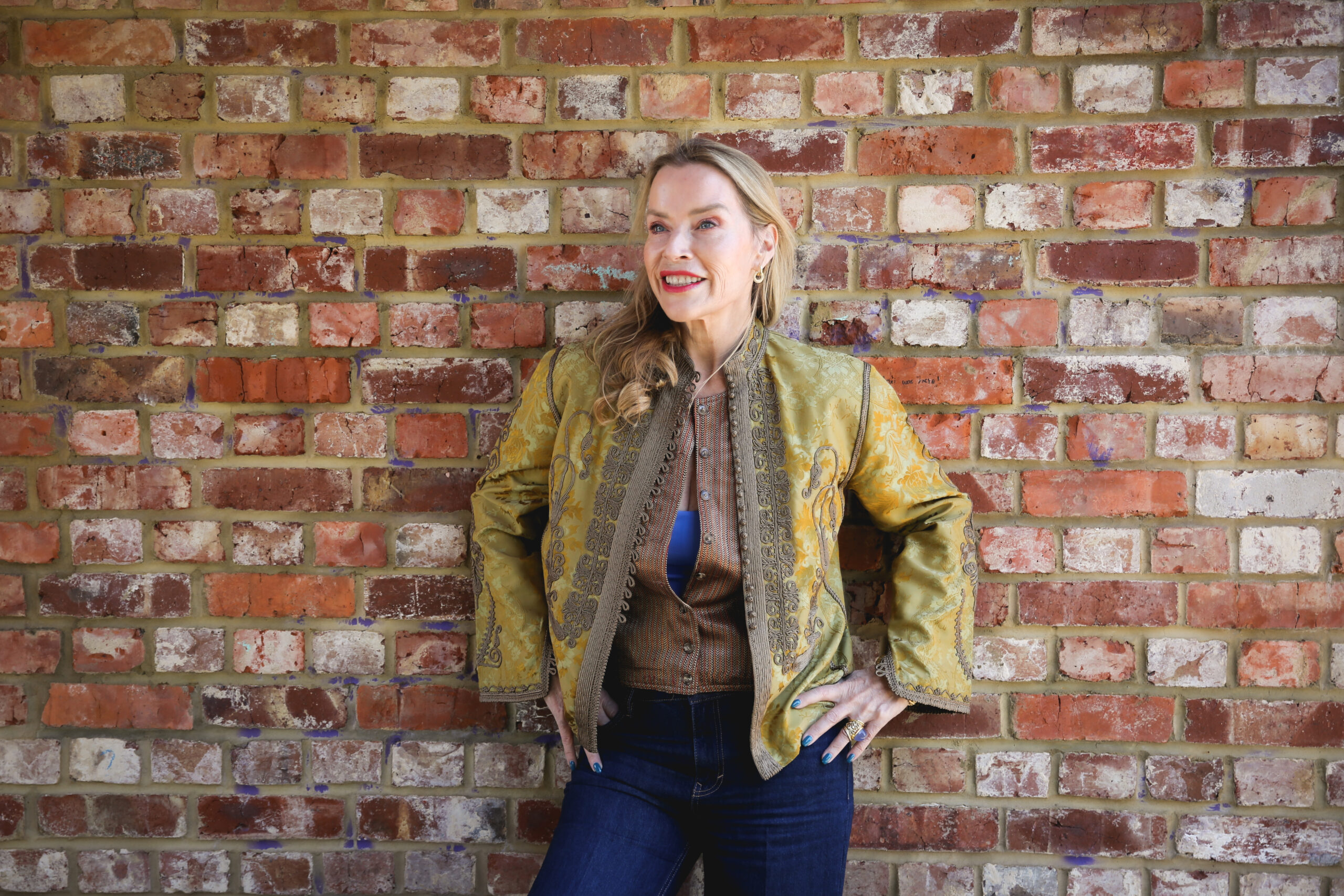
Non-Sexual Touch: What Happened When a Million People Watched My Partner Trace My Jaw
The outrage told me everything about why intimacy is breaking down.
A million people watched my partner trace my jaw.
He did it slowly, fingertips only, the lightest possible contact along the line from temple to chin. I received it with my eyes closed, my jaw softened, doing nothing but feeling it land.
Forty-eight hours later my inbox was full of fury. Finger-wagging messages from people who had decided what they were watching.
“Who do you think you are? What are you teaching? Are you not embarrassed?”
None of them saw what I saw.
The other half of my inbox, the larger half, the quieter half, was people saying: “I watched it four times and I don’t know why I cried.”
Women who had not been touched like that in years. Men who had no idea it was even possible. Couples who had forgotten something they could not name.
That contrast is the whole of my work in a single video. The outrage and the longing are the same information. They are both telling you how far we have drifted from non-sexual touch as a category, and what that drift costs us.
WE LOST THE MIDDLE
Here is how intimacy breaks down in most long-term relationships. There is the functional touch: a peck goodbye, a hand squeezed in passing, the logistics of two bodies moving through a shared life. There is, occasionally, the sexual kind. Everything in the middle, touch that is tender and slow and asking absolutely nothing, has quietly disappeared.
It did not leave dramatically. It faded the way things fade when life gets full: children, jobs, the slow accumulation of small distances no one thought to name. At some point the only time bodies meet is out of habit, or as a gateway to something else.
The numbers bear it out. Research by Dr Tiffany Field at the Touch Research Institute found that 68% of adults are touch-deprived even when living with other people. Only 32% report touching their partner often. 98% are on their phones. No-touch policies in schools, the rise of screens in every room, lives lived increasingly at the distance of a glass surface: we are, measurably, touching each other less than any previous generation.
When that middle disappears, the body learns a new lesson. Every touch becomes loaded. Touch means something is about to be asked. The shoulder learns to tighten when a hand lands, not because there is no love, but because the body has been taught that touch is currency and the body is tired of being spent. A body that has only ever been reached for in one direction learns to brace. The shoulder that stiffens is not being difficult. It is being accurate.
WHY RECEIVING FEELS SO DANGEROUS
Here is the part almost nobody talks about: the difficulty with touch is not just that we have less of it. It is that we were taught, very early and very thoroughly, that the body itself is dangerous.
For many of us, that teaching came from religion. From the idea that the body is something to be managed, covered, suppressed, offered only inside specific conditions and never for its own pleasure. The skin became something to be ashamed of. Touch became something that required permission from structures far outside ourselves.
For others it came from families where touch was conditional, inconsistent, or simply absent. Where the body learned that closeness was unpredictable. Where being reached for sometimes meant something was about to be taken.
Over time, the lesson calcifies: receiving is passive, therefore weak. Wanting touch is needy, therefore embarrassing. Allowing yourself to be felt is exposure, therefore risk.
So we learned to manage it. To flinch, deflect, smile it off, turn it into performance, make a joke, speed it past the uncomfortable part into something more familiar.
Here is the thing I keep coming back to, the thing that cuts through every layer of conditioning: every single one of us arrived through an act of touch. The body was always the beginning. Before doctrine, before the rules about what the skin was allowed to feel, there was a moment of contact that made us possible.
Somewhere along the way we were taught to be ashamed of that. The shame did not land just on sex. It landed on touch itself, on the skin, on the simple fact of having a body that wants to be met. The outrage in my comments was not really about me and my partner. It was the sound of that shame meeting something it had forgotten how to name.
“Receiving is a skill, and most bodies have lost it. When you are touched with no demand attached, your nervous system gets to learn that closeness is not a transaction.”
WHAT NON-SEXUAL TOUCH ACTUALLY DOES
The video was a single moment from a practice I call the Trace Ritual. It is one of ten structured touch practices I teach couples, and the key word is structured.
I do not tell couples to connect more. I design the room the body finally trusts enough to come back into. Structure is what makes that room safe. When you know exactly what you have agreed to, a two-minute container with nothing that needs to go anywhere after, your nervous system stops scanning and starts receiving.
What you cannot see in the video is everything underneath it. A woman who has practised receiving without flinching, managing, or turning it into something that has to go somewhere. A partner who has slowed down enough to give without wanting anything back.
Almost nobody is taught either of those things. Which is why almost everybody in the comments was certain they were watching something else.
A 2021 review in Neuroscience and Biobehavioral Reviews found that affectionate, non-sexual touch reduces cortisol, increases oxytocin, and shifts the nervous system out of protective activation. The body physically changes in response to a different quality of touch.
Sexual touch asks: am I wanted? Non-sexual touch answers something older and quieter: am I safe here?
You cannot skip to the first question if the second one has not been answered. Most couples have been skipping it for years.
THE TRACE RITUAL: INVITE HIM TO TRY THIS TONIGHT
This is the practice from the video. You do not need any particular mood, any preparation, or anything to have been resolved between you first. You are the one receiving. That is the whole practice.
Ask him. “Can you trace my face for two minutes? No agenda. Nothing needs to happen after this.” Wait for a genuine yes from him, and give one yourself.
Agree the container. Two minutes. You do nothing but feel. He does nothing but give. Say it out loud: this is not going anywhere else. That agreement is what makes it safe. The body can fully arrive into a container it trusts.
Receive. Close your eyes. Soften your jaw. Let your hands rest in your lap. Your only job is to feel the touch land, and to stay with it when the urge comes to smile it off, hurry it along, or turn it into something. Notice that urge. Let it pass.
Let him give. He starts at the temple or the edge of the jaw, fingertips only, slower than he thinks slow is. Like honey. If he watches where your breath changes and follows that, that is exactly right.
One word. When the two minutes end, say one word for what you felt. Not an explanation. One word. He receives it by saying: thank you.
Afterwards, notice: where did you want to speed it up or make it mean something? Where did the urge to perform or manage it come in? That is where your body has been bracing. That is where the work begins.
“Intimacy was never spontaneous. It is built, from the least dramatic touch in the house.”
If it feels unfamiliar, that is the information. The body is telling you how long it has been since touch had no agenda. Use that as the reason to keep going.
WHAT A MILLION VIEWS ACTUALLY PROVED
I have sat with more than seven hundred and fifty women around intimacy, desire, and the body. The story I hear most is not one of dramatic breakdown. It is the slow disappearance of the middle: the touch that is just touch, the presence that asks nothing, the moment of being met with no transaction attached.
The women who filled my inbox that week, the furious ones and the ones who watched it four times in silence, were feeling the same thing from different directions. Recognition. The ache for something the body remembered and the life had quietly taken away.
Non-sexual touch is the foundation the whole house is built on. Without it, the body braces. With it, the body finally gets the chance to come home.
The jaw trace is two minutes. The shift it creates is not.
—
FREE FOR CONFIDENCE READERS: The 10 Touch Rituals, the complete set of structured practices including the Trace Ritual. Go here to get it free:
https://feelfullyyou.com/confidence
—
Juliette Karaman helps women who still love their partner but feel the touch has gone quiet find their way back to closeness, desire, and their own body. If you have done the books, the date nights, even the therapy, and still feel numb or braced, this is the work that moves it. www.feelfullyyou.com. IG @juliettekaraman